
Weekly Blog #22
“Fannie Mae and Freddie Mac are neither fish nor fowl. They are private companies with public purposes, and they benefit from an implicit government guarantee.”— Ben Bernanke
Few outside the mortgage industry truly understand what FNMA and FHLMC—commonly known as Fannie Mae and Freddie Mac—actually do. Fannie Mae was established in 1938 as part of FDR’s New Deal, and Freddie Mac received its congressional charter in 1970. Both were created to provide and support an active secondary mortgage market, expand liquidity, and ensure a stable supply of mortgage credit.
Fannie and Freddie are unique in American capitalism. They are shareholder-owned corporations, yet they operate under federal charters that carry an implicit government guarantee. That implied backstop materially lowers their cost of capital by roughly 80–90 basis points relative to commercial banks making true private-sector competition effectively impossible. As Bernanke famously observed, the government sponsored enterprises (GSEs) are “one part fish, one part fowl.”
The contradictions inherent in that structure came fully into view during the Great Financial Crisis. Both GSEs suffered catastrophic mark-to-market losses on their mortgage portfolios and were placed into federal conservatorship in 2008. Seventeen years later, they remain there—so long, in fact, that many Americans are unaware they were ever private companies at all.
When mortgage-backed securities collapsed, the federal government did backstop the GSEs—injecting a combined $191 billion to stabilize them. What is far less discussed is what followed. Since entering conservatorship, Fannie Mae and Freddie Mac have remitted approximately $301 billion to the U.S. Treasury—far more than the original rescue. Which raises an obvious question: why are they still under government control?
President Trump has repeatedly criticized the nationalization of U.S. oil assets by Venezuela in the 1970s, including the seizure of operations belonging to Exxon, Gulf Oil, and ConocoPhillips. Nationalization is widely understood to be an affront to property rights, rule of law, and free-market capitalism. Yet the U.S. government has effectively done the same thing to Fannie and Freddie—indefinitely.
The reasons are real, but they are not principled. They include political resistance from policymakers who view the GSEs as tools for affordable housing policy; unresolved post-crisis capital requirements; and fear that fully privatized entities might once again require a future bailout. These concerns may be understandable—but they do not justify perpetual conservatorship.
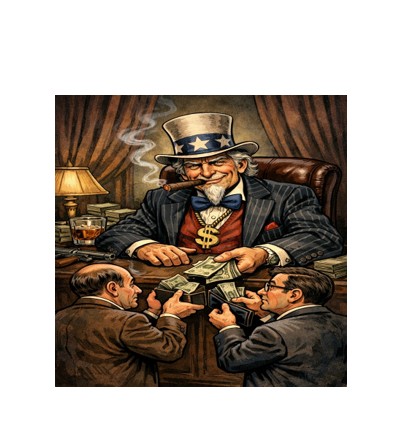
What the government is doing now is neither capitalism nor prudent regulation. It is closer to a protection racket: the state guarantees the entities’ survival, then confiscates all profits in perpetuity. Either the United States believes in private ownership and market discipline, or it does not. Karl Marx envisioned government seizure of productive assets and redistribution of profits. By that standard, the ongoing treatment of Fannie and Freddie would earn his approval.
Capital markets price and allocate risk. Investors risk capital in exchange for the possibility of return—and accept losses when risks are mispriced. That system breaks down when profits are privatized and losses socialized. But it also breaks when the inverse occurs. Bondholders of the GSEs were made whole, as contracts require. Common and preferred shareholders, however, have endured nearly two decades of zero dividends and share prices reduced to pennies—despite the companies’ sustained profitability.
Markets function only when rewards and consequences are symmetrical. Too big to fail, once a marginal concept, became doctrine during the Great Financial Crisis—and it continues to distort incentives. It misprices risk, misallocates capital, and entrenches moral hazard. Whether profits or losses are socialized, the result is the same: dysfunctional markets.
History offers a clear contrast. Prior to nationalization, Venezuela produced roughly 3.5 million barrels of oil per day. Today, production has collapsed to approximately 800,000 barrels per day—a decline of nearly 80%. Over the same period, GDP per capita fell from roughly $16,000 to $3,600, an equally devastating reduction in living standards.
Capitalism does not merely redistribute wealth; it creates it—through investment, innovation, and efficiency. Sending a government-run rocket around the moon costs roughly $5 billion. SpaceX can accomplish similar missions for under $100 million. The choice is not abstract: do we want institutions that operate like the DMV, or like Amazon, SpaceX and Costco?
The federal government must eventually decide which tradition it intends to follow: the Founders’ vision of limited government, property rights, and economic freedom—or the path taken by Marxist regimes that centralize control and stifle enterprise. One path leads to innovation, abundance, and prosperity. The other leads to Venezuela.
Mark Lazar, MBA
CERTIFIED FINANCIAL PLANNER™