
“A recession is when your neighbor loses his job. A depression is when you lose yours.” Ronald Reagan.
If you simply read the headlines, you would likely come away with a sense of dismay, if not outright alarm. The 24-hour news cycle is in full swing, and every article seems to present a dour perspective on the Iran war, oil prices, impending AI job destruction, weak job growth, unaffordability, softening home prices, inflation, deficits, political dysfunction, and whatever else can be packaged into a crisis before lunch. But is the economy really as bleak as the headlines suggest?
As usual, the answer depends on what we are measuring. Economists can provide a myriad of data points: GDP, employment, unemployment, real wages, inflation, household net worth, stock prices, housing activity, retail sales, consumer sentiment, and so on. These are useful. But they are also aggregates. They describe the economy in total, not necessarily the economy as experienced by any one person, family, business, or borrower.
Adam Smith famously observed that society is composed of individuals pursuing their own interests. That is not a cynical view of humanity; it is an observation of reality. We tend to view the economy through the lens of our own household. Am I employed? Are my wages keeping up? Can I afford a home? Is my business growing? Are my investments rising? Are my costs under control? In other words, “the economy” and “your economy” are not always the same thing.
So how is the U.S. economy doing? The labor market remains reasonably healthy, though not spectacular. The most recent BLS report showed the economy added 178,000 jobs in March, while the unemployment rate remained low at 4.3%. That is not recessionary on its face. Layoffs also remain relatively contained, with weekly jobless claims recently at 200,000, still historically low. This is not a booming labor market, but neither is it collapsing. It looks more like a cautious labor market: employers are not aggressively hiring, but they are also not aggressively firing.
Real wages are more mixed. Nominal wages are still rising, but inflation has eaten into much of the gain. Real average hourly earnings rose only modestly over the past year, with BLS reporting a 0.3% increase from March 2025 to March 2026. That means workers are generally moving forward, but not by much. For many households, that distinction matters. A paycheck can be higher in dollar terms while still feeling disappointingly flat in purchasing-power terms.
Economic growth is also positive, though hardly euphoric. Real GDP increased at a 2.0% annualized rate in the first quarter of 2026, following only 0.5% growth in the fourth quarter of 2025. That is respectable, especially given higher interest rates, geopolitical uncertainty, and elevated energy prices. But it is not the kind of growth that makes everyone feel flush. It is expansion, not exuberance.
Inflation remains the sore spot. The CPI rose 3.3% over the 12 months ending in March, up from 2.4% the prior month. Core inflation, excluding food and energy, was 2.6%, while energy prices were up 12.5% year over year. This is the part of the economy people feel most directly. Even when inflation slows, prices rarely go back to where they were. The rate of increase may moderate, but the higher price level remains. That is why many consumers remain frustrated even when economists point to “cooling inflation.”
The stock market, however, tells a more optimistic story. Despite daily volatility, the S&P 500 has been up roughly 7% year-to-date, while the Nasdaq has been even stronger, helped by continued enthusiasm around artificial intelligence and technology earnings. Stocks are not the economy, but they are a forward-looking barometer of corporate profits, liquidity, and investor expectations. At the moment, investors appear cautious, but not fearful.
Housing is more complicated. Existing-home sales remain subdued, with March sales running at 3.98 million annualized units. The median existing home price was $408,800, up 1.4% from a year earlier, and inventory stood at 4.1 months. In plain English, home prices have not broadly collapsed, but affordability remains strained. Higher mortgage rates, elevated prices, insurance costs, taxes, and stagnant real wages have made homeownership feel increasingly out of reach for many buyers.
Consumers, meanwhile, are still spending. Retail and food services sales rose 1.7% in March and were up 4% from a year earlier. That suggests the consumer is not dead, despite endless predictions to the contrary. However, retail sales are reported in nominal dollars, meaning higher prices can make spending look stronger than the actual volume of goods purchased. Still, consumer spending has remained more resilient than many expected.
Household balance sheets also remain strong in aggregate. The Federal Reserve reported that household net worth rose to $175 trillion in March, a staggering number, supported by elevated home values, financial assets, retirement accounts, and business ownership.
The U.S. economy is still growing. People are employed. Real wages are rising, though modestly. Consumers are spending. Corporate profits and stock prices remain strong. Housing activity has slowed, but prices have not broadly cratered. By traditional measures, this is not a recession. But it also does not feel uniformly healthy. Inflation has repriced daily life. Housing affordability remains strained. Borrowing costs are elevated. Energy prices, geopolitical risk, and AI disruption all add uncertainty. For many households, the question is not whether GDP is positive, but whether their own income, savings, and purchasing power are improving.
That is the distinction. The macro economy can be healthy while many individual households feel squeezed. Both can be true.
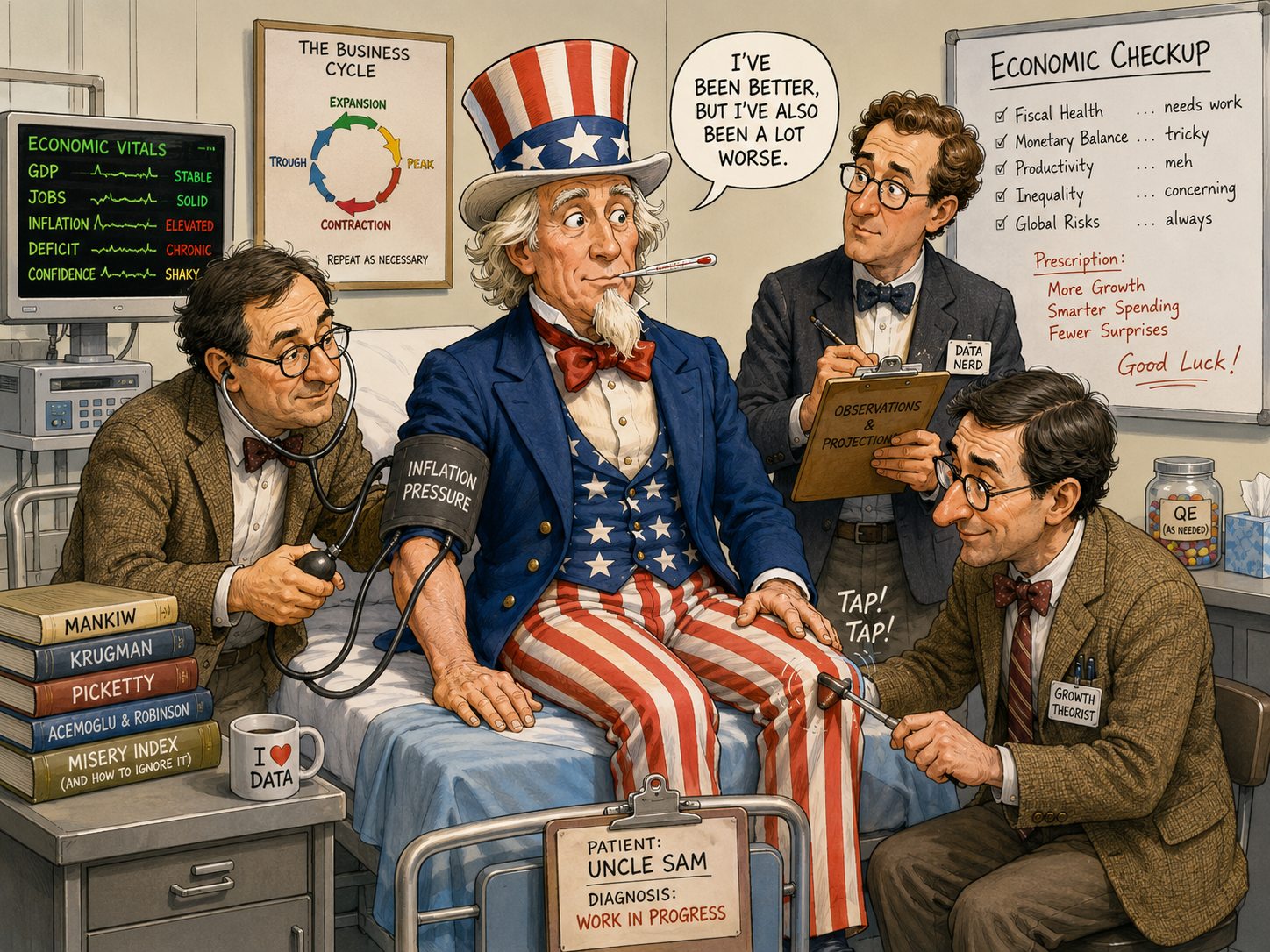
The headlines want drama. The data suggests nuance: resilient, imperfect, expensive, and uneven. Not a boom. Not a bust. More like a patient who could lose a few pounds, lower his stress, and cut back on salt—but is still very much alive.
Mark Lazar, MBA
CERTIFIED FINANCIAL PLANNER™