
“The most important item over time in valuation is interest rates.” — Warren Buffett
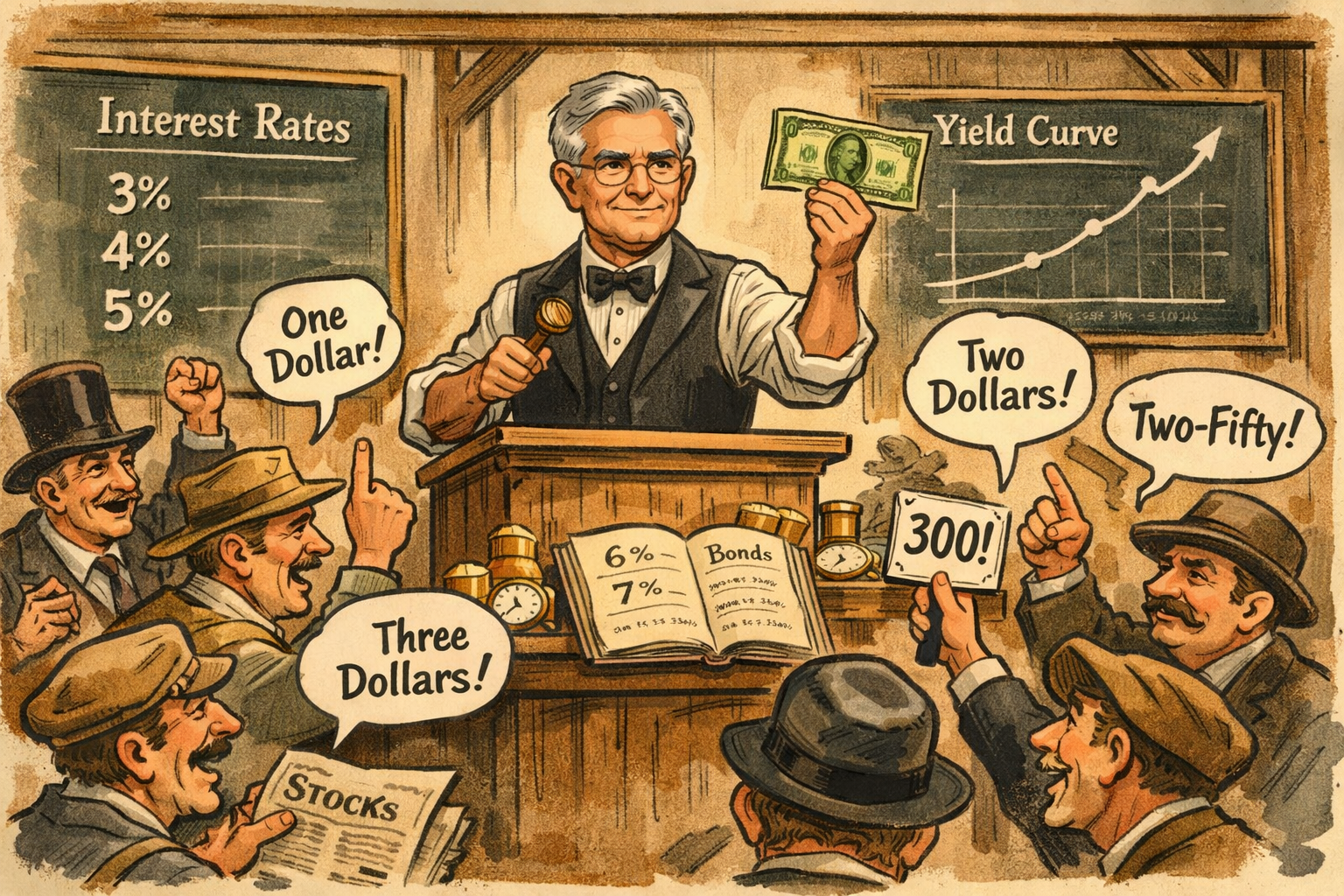
Every market has a price. Labor has wages. Goods have prices. Real estate has rents. Capital has a cost. And money, the most important coordinating mechanism in a modern economy, has a price as well. That price is the interest rate, and few prices matter more.
Interest rates are not simply a technical detail of finance. They are the economy’s central signaling mechanism. They influence what we build, what we invest in, what we consume, what we save, and ultimately how efficiently capital is allocated. When the price of money is allowed to emerge from the interaction of borrowers and lenders—the forces of supply and demand—it performs the same function as any other market price: it transmits information. When that price is managed, suppressed, or manipulated, the signal becomes distorted. And when signals are distorted, decisions become distorted.
Interest rates sit at the heart of asset valuation. In real estate, for example, the cap rate—the relationship between income and value—is directly tied to the cost of capital. When interest rates fall, investors are willing to accept lower yields, which pushes property values higher. When rates rise, the reverse occurs. The same principle applies to equities. Stock prices reflect the present value of future cash flows, discounted by the prevailing cost of capital. Lower rates increase present values. Higher rates compress them.
Currencies are no different. Interest rate differentials influence capital flows across borders, affecting exchange rates and the relative strength of national economies. In each case, interest rates function as the price of time—the cost of bringing future consumption into the present.
This is why the distinction between market-determined interest rates and centrally managed rates matters so deeply. In a market system, interest rates reflect the collective judgment of savers and borrowers about risk, inflation, productivity, and time preference. They are not arbitrary numbers. They are the product of decentralized decision-making. When central authorities intervene to suppress or manipulate those rates, they are not merely adjusting a policy lever. They are influencing the economy’s most important price signal.
Artificially low interest rates encourage borrowing and discourage saving. They make long-duration assets appear more valuable than they might otherwise be. They incentivize risk-taking, leverage, and speculative behavior. Over time, this can inflate asset prices beyond levels justified by underlying fundamentals. Bubbles are not simply the result of optimism—they are often the consequence of mispriced capital.
Conversely, when rates rise rapidly after a prolonged period of suppression, the adjustment can be abrupt and painful. Projects that once appeared viable under ultra-low financing costs suddenly become uneconomic. Asset valuations reset. Leverage becomes a liability rather than an advantage. Economies naturally move through business cycles, but the severity of those cycles is often amplified by prior distortions in the price of money.
The broader issue is allocational efficiency. In a well-functioning market, capital flows toward its highest and best use. Interest rates help determine where that flow occurs. When the price of money is artificially altered, capital may be directed toward projects that are not economically sustainable. Over time, such misallocation reduces productivity and undermines long-term prosperity.
This is not an argument against central banks or monetary authorities per se. Modern economies require institutions to manage liquidity, stabilize financial systems, and serve as lenders of last resort. Rather, it is an argument for humility in the exercise of that authority. The more aggressively policymakers attempt to engineer outcomes through interest rate management, the greater the risk of unintended consequences.
Markets are imperfect, but they possess an extraordinary capacity to aggregate dispersed information. Interest rates that emerge from market processes reflect real preferences, real risks, and real expectations. They provide a feedback mechanism that disciplines both borrowers and lenders alike. When that mechanism is suppressed, the discipline weakens.
At its core, the price of money is about more than finance. It is about the coordination of economic activity across time. It shapes whether societies prioritize consumption or investment, speculation or production, short-term gain or long-term growth.
When the price of money is determined by markets, capital flows more efficiently. Savings are rewarded appropriately. Investments are evaluated more rigorously. Asset prices are more closely aligned with underlying fundamentals. But when the price of money is manipulated, those relationships become less reliable.
Understanding the price of money is therefore essential to understanding the economy itself. It explains why asset values rise and fall, why currencies strengthen or weaken, and why cycles of boom and bust recur.
In the end, interest rates are not merely a policy tool; they are the economy’s most consequential price—the cost of capital, the price of time, and the signal that guides the allocation of resources across generations.
When that signal is clear, markets function with greater efficiency. When it is obscured, the consequences ripple through every corner of the financial system. That is the true price of money.
Mark Lazar, MBA
CERTIFIED FINANCIAL PLANNER™