

“I’ll gladly pay you Tuesday for a hamburger today.” Wimpy
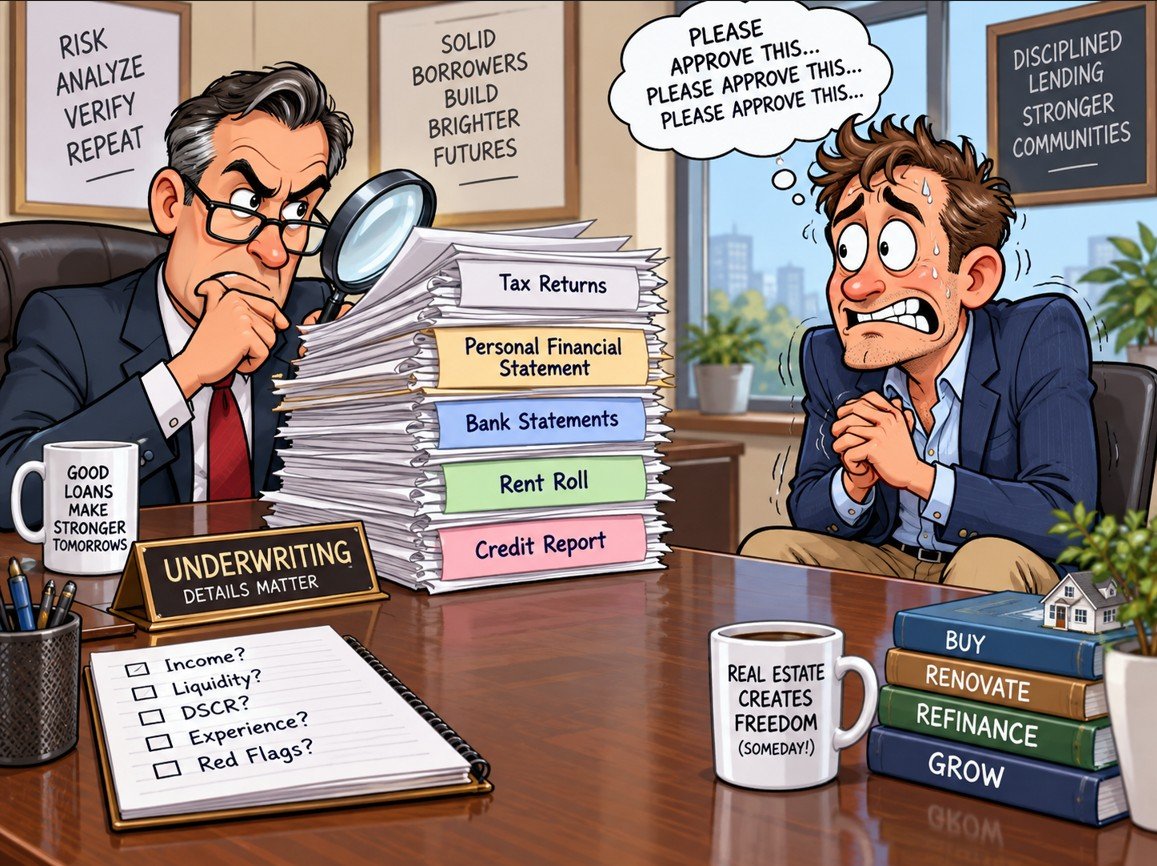
Suppose a borrower walks into your office. We’ll call him Sam. Sam earns roughly $56,000 per year. Not extraordinary, but workable. Plenty of borrowers with similar income manage their finances responsibly. Then you open the file.
Sam spends approximately $75,000 per year. Before taking on any new obligation, he is already spending $19,000 more than he earns. This is not temporary. It is structural. Sam is living beyond his means.
His balance sheet is no better. Sam already owes approximately $400,000, with annual debt service of roughly $12,000. He has no savings, no reserves, and no serious plan to bring spending in line with income.
Then there is the part that does not show up cleanly on the credit report. Sam has made promises: future payments, long-term commitments, and benefits pledged to others. The present value of those promises is about another $800,000.
The file looks something like this:
- Annual income: $56,000
- Annual spending: $75,000
- Mandatory expenses: $56,000
- Discretionary expenses: $19,000
- Existing debt: $400,000
- Annual debt service: $12,000
- Additional unfunded obligations: $800,000
- Savings: None
Would Sam qualify for a conforming mortgage? Nope!
In addition to $12,000 of annual debt service Sam also has $56,000 of mandatory, non-discretionary expenses. These aren’t casual lifestyle choices—they are commitments he cannot avoid without serious consequences. Interest must be paid.
On top of those commitments, Sam spends another $19,000 per year on discretionary items, funded entirely with borrowed money.
So the real underwriting question isn’t whether Sam’s scheduled debt service fits inside a conventional DTI box. The question is whether he has any free cash flow available for a new mortgage payment. He doesn’t.
His income is already fully consumed by mandatory obligations before accounting for discretionary spending, future promises, or any new loan payment. On a practical debt-service or coverage basis, Sam’s ratio is not merely weak. It is upside down.
By now, you have probably figured out that Sam’s full name is Uncle Sam. The numbers above are the federal budget scaled down to household size. For fiscal year 2026, the federal government is expected to collect roughly $5.6 trillion in revenue and spend $7.5 trillion, leaving a deficit of $1.9 trillion. Divide everything by 100 million, and the federal government looks like a household earning $56,000 and spending $75,000.
The debt picture is worse. Total federal debt is approaching $40 trillion. Scaled down, Uncle Sam owes roughly $400,000 against $56,000 of annual income. Even more troubling, mandatory spending and interest expense consume about $57,000 on the same household scale—more than his 100% of income before a single dollar is spent on discretionary programs.
Then come the future promises. The government’s formal debt does not fully capture long-term shortfalls in Social Security and Medicare. Those obligations are real claims on future taxpayers. On our household scale, they add another $800,000. To quote the line in Top Gun; Sam is writing checks his body can’t cash.
But the United States is not a household. A household cannot tax, issue the world’s reserve currency, borrow in money it creates, or draw upon America’s productive capacity. Those differences matter. But they do not make arithmetic disappear.
A country can obtain more credit than a household, carry it longer, refinance more easily, and grow its way out of problems that would crush an individual borrower. But even sovereign borrowers face limits. If debt grows faster than the economy, creditors require higher interest, which consumes more of the budget.
Eventually, choices that were once optional become unavoidable: raise taxes, cut spending, reform entitlements, inflate the currency, grow faster, borrow more, or some combination of the above.
The political temptation is to “borrow more” as long as markets permit it. Borrowing is easier than reform. It avoids hard conversations. It allows politicians to promise benefits without asking voters to pay the full cost today.
But lenders understand something politicians often ignore: trajectory matters. Debt itself is not the problem. The issue is whether the borrower has the discipline, prudence, and character to repay it.
On that score, Uncle Sam’s file is troubling. America is not poor. The problem is not capacity. The problem is discipline.
Sam would not qualify for a conforming mortgage loan. Not because Sam lacks income or assets. But because Sam spends far more than he earns, has no reserves, is already highly leveraged, and continues making promises he hasn’t figured out how to fund.
The borrower is not bankrupt, but the trajectory is broken. And lenders should never ignore a broken trajectory.
Mark Lazar, MBA
CERTIFIED FINANCIAL PLANNER™