
“This process of Creative Destruction is the essential fact about capitalism.” Joseph Schumpeter
Part II followed the money. Now let’s follow the jobs.
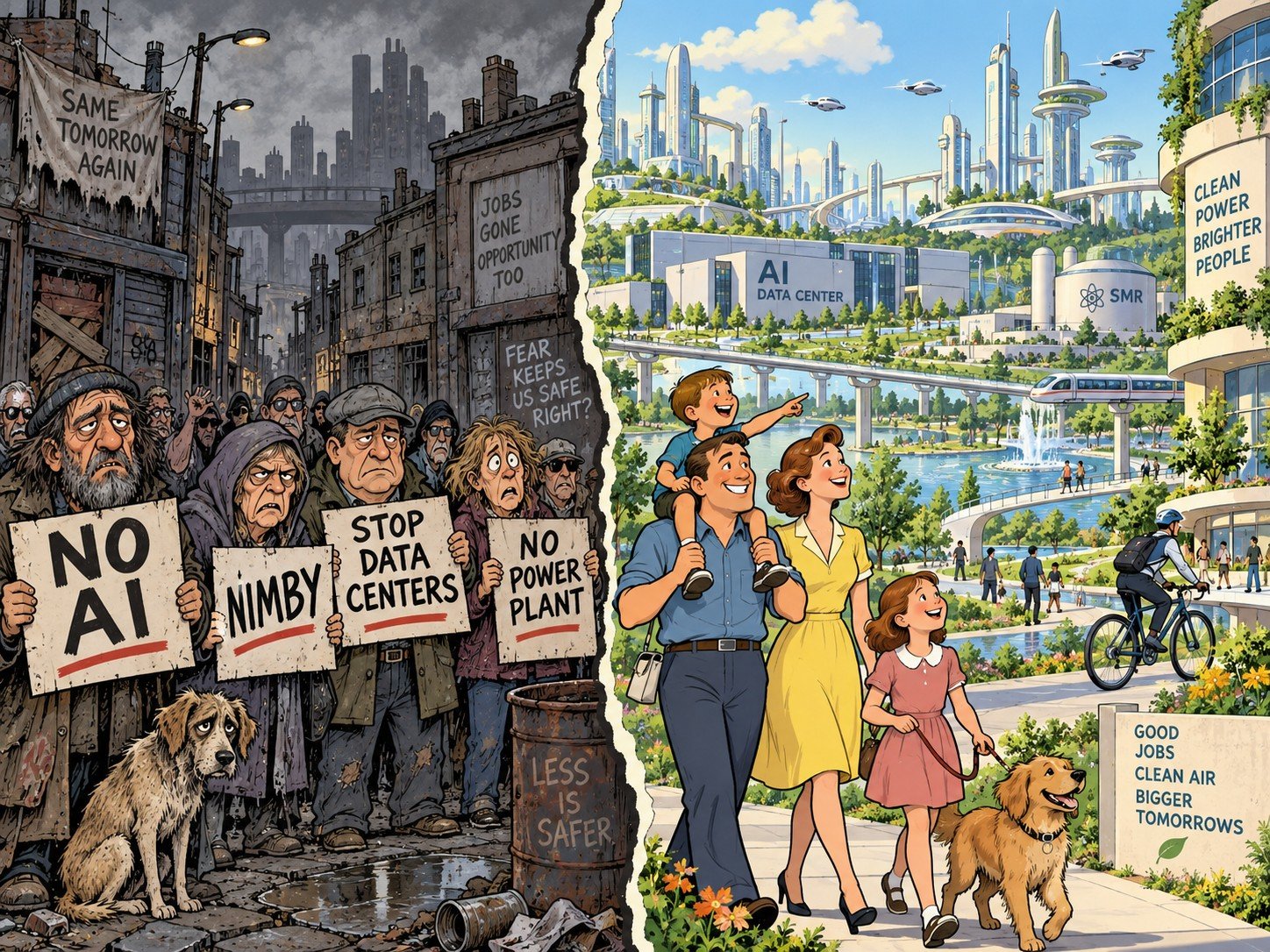
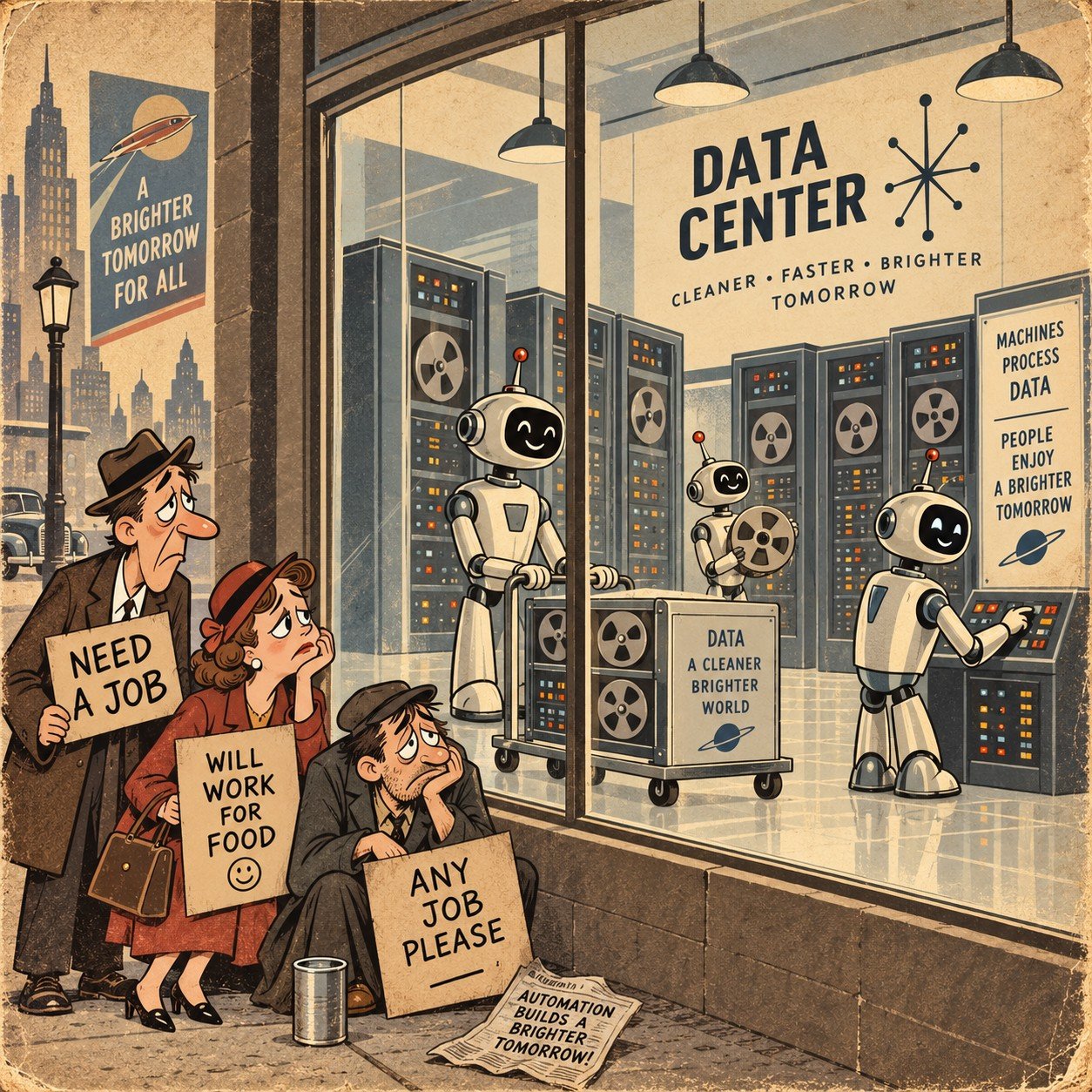
The criticism comes in two forms: First, data centers don’t create any meaningful jobs and, second, the AI they power is about to destroy yours.
That second one is easy to understand. In 2025, Anthropic CEO Dario Amodei warned that AI could eliminate half of entry-level white-collar jobs and drive unemployment to 10%–20% within one to five years. Sam Altman warned that “entire classes of jobs will go away.”
If those headlines scared the hell out of people, I get it. They rattled me a bit too—and I’m well versed in Schumpeter’s creative destruction. Whenever someone says, “Yeah, but this time is different,” I tend to raise a Spock-like eyebrow. History may not repeat itself, but it oftentimes rhymes.
CLAIM #1: “Data centers don’t create any jobs!” FACT: There’s a kernel of truth buried inside the claim: data centers are enormously capital-intensive, not labor-intensive.
But building a data center takes roughly 12–18 months and requires 1,500 workers on site at peak construction. Statewide, JLARC estimates the industry contributes roughly 74,000 jobs, $5.5 billion in labor income and $9.1 billion in GDP annually.
Loudoun County alone reports more than 17,000 direct and indirect data-center-related jobs. Are data centers giant permanent-employment factories? Nope. The typical data center employs roughly 50 full-time people once operational. But ask the excavators, graders, steelworkers, electricians, plumbers, welders, HVAC technicians, glass installers and thousands of other tradesmen whether data centers create jobs.
CLAIM #2: “Yeah, but most of those are construction jobs!” FACT: Construction jobs are jobs.
Nobody dismisses the economic value of building factories, power plants, highways or houses because the electricians and pipefitters eventually finish the job and move to the next one.
And with data centers, there’s one hell of a “next one.”
A 2026 study estimates data-center capital spending supported about 1.71 million U.S. jobs in 2024—up 56% in one year. The broader industry supported an estimated 5.5 million direct, indirect and induced jobs. But even that misses the larger point.
A data center is infrastructure. Measuring its economic value by counting the people standing inside it is like measuring an airport by counting air-traffic controllers—or a power plant by counting people in the control room.
Amazon, Microsoft, eBay and countless other technology platforms don’t create economic value solely through the people on their payrolls. They enable millions of jobs and businesses that depend on their infrastructure. Data centers work the same way.
The compute supports banking, healthcare, logistics, software, communications, engineering, e-commerce and increasingly AI itself. The jobs enabled by compute don’t have “DATA CENTER” stamped on their paychecks.
CLAIM #3: “Fine. But AI is going to destroy everybody else’s jobs!” FACT: AI will destroy some jobs. And will create even more.
The newest BLS projections expect office and administrative-support employment to decline by about 752,000 jobs between 2025 and 2035. AI and automation are explicitly among the reasons for declines in occupations such as clerical and administrative work. But here’s the part the apocalypse headlines usually leave out. The same BLS projections forecast 5.9 million net new U.S. jobs over that decade. Computer and mathematical occupations add roughly 403,000. Software developers add about 175,000. Data-scientist employment grows roughly 35%.
And BLS specifically projects AI-driven demand to help computing infrastructure, data processing and web-hosting employment grow 25.1%, adding about 120,400 jobs. AI-related electricity demand is also expected to drive employment growth in power generation and infrastructure.
Something else happened after the scary predictions: by May 2026, Altman said the global “jobs apocalypse” he had feared now appeared unlikely. That doesn’t mean everyone wins. Some jobs disappear. Others are created. Most evolve. Productivity rises, costs fall and entirely new products, businesses and occupations become economically viable. That’s creative destruction.
SO WHAT DID WE LEARN?
Data centers are capital-intensive infrastructure. Permanent employment inside an individual building is relatively modest. But stopping the analysis there is economically myopic. Building them employs armies of tradespeople. Operating them creates technical jobs. Their supply chains support millions more. And the infrastructure boom they’re driving requires power generation, transmission, fiber, networking and equipment.
As for the AI jobs apocalypse? Disruption is real. Some occupations will disappear and millions of workers will have to adapt. But thus far, the evidence looks a lot more like Schumpeterian creative destruction than the end of work.
Technology is the engine of productivity, wealth creation and rising living standards. It raises wages, lowers costs, cures disease, extends lives and gives ordinary people a standard of living that kings could only dream of a few generations ago.
We can fight technology. The Luddites did. But if past generations had won that fight, we’d still be riding in horse-drawn carriages, lighting our homes with whale oil and crossing the country by steam locomotive.
Part IV: “Nobody Wants One Next Door, AKA NIMBY” — Let’s talk about the legitimate concerns.
Mark Lazar, MBA
CERTIFIED FINANCIAL PLANNER™