
Prosperous economies use lots of energy. Poor ones don’t.
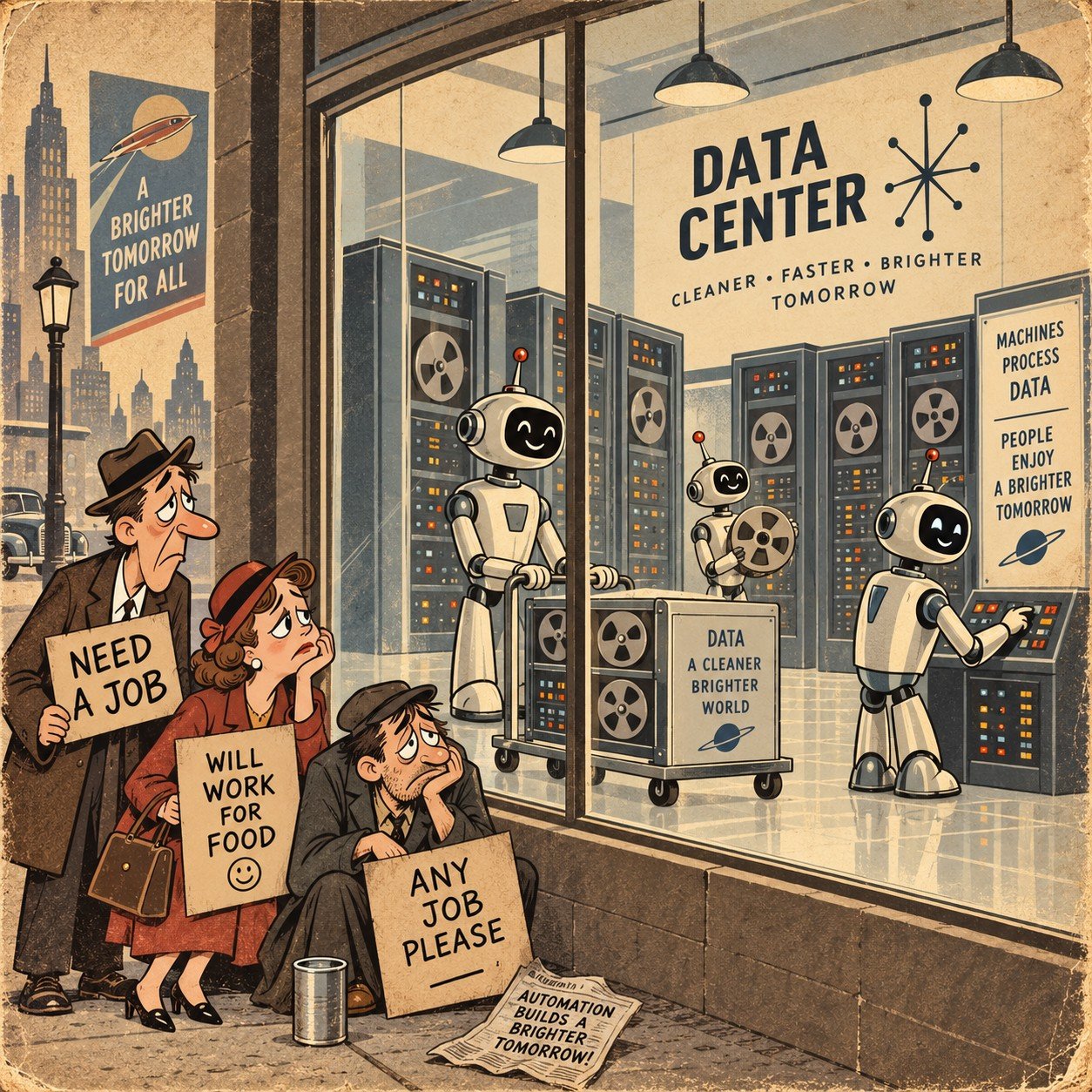
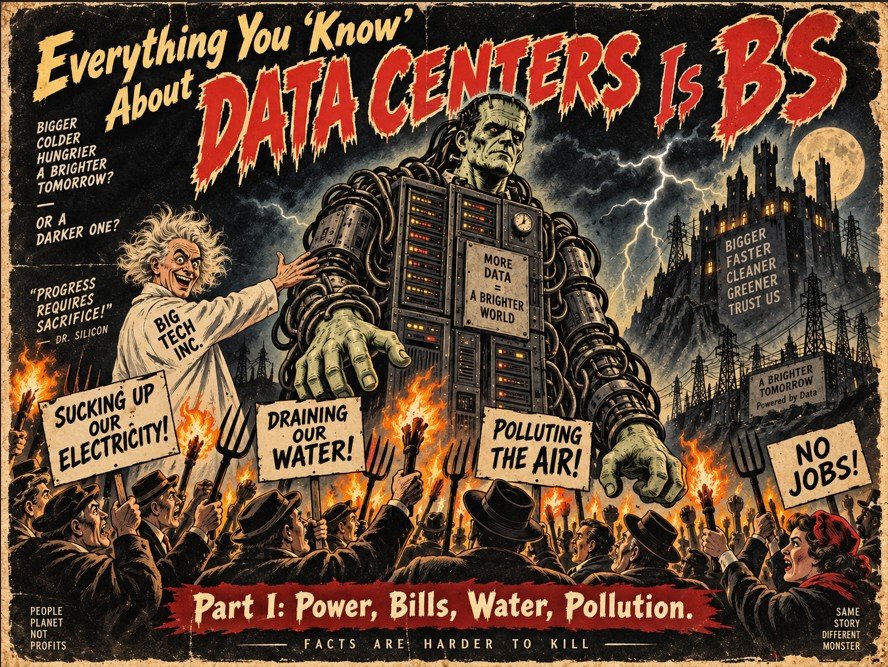
Data centers have become one of America’s favorite bogeymen. Depending on which headline you read, they’re sucking up our electricity, jacking up power bills, draining our water, polluting the air, collecting corporate welfare, creating no jobs — and the AI they power is coming for the jobs we do have. Some of those concerns are real. Some are half-truths. Some are bullshit.
This four-part MythBusters series takes the major claims and compares them with the best available data. Part I tackles power consumption, electric bills, water and air pollution. For context, a data center is basically an industrial-scale computer: thousands of servers and processors providing the compute behind AI, cloud services, banking, healthcare, streaming and much of the digital economy. Now to the claims.
CLAIM #1: “They’re sucking up all our electricity!” FACT: U.S. data centers consumed nearly 313 terawatt-hours in 2025, roughly 7% of total U.S. electricity use, up ~26% YoY, and about 81% since 2020. That’s enormous—and a sign of economic growth.
Prosperous economies use lots of energy. Poor ones don’t. Among wealthy countries, electricity use and GDP per capita are correlated at roughly 0.9. Energy powers production, automation, transportation, computing and productivity. No advanced industrial economy has ever been built on energy scarcity.
After nearly 15 years of essentially flat U.S. electricity demand—just 0.1% annual growth from 2005–2019—AI and data centers are driving growth again—and pulling massive amounts of private capital into new generation. Meta alone has announced agreements supporting up to 6.6 GW of nuclear power. Rising demand is signaling the market to invest and build. That’s progress.
CLAIM #2: “Data centers are making everybody’s electric bill skyrocket!” FACT: The best recent causal study found the opposite. Doubling data-center capacity was associated with about a 3.5% decline in residential electricity rates, while data-center growth from 2019–2024 lowered rates roughly 6% versus what they otherwise would have been. More demand spreads the grid’s enormous fixed costs over more kilowatt-hours.
Virginia—the nation’s data-center capital—is the obvious reality check: in 2024, residential electricity averaged 14.41¢ per kWh versus 16.48¢ nationally—about 13% cheaper.
The evidence says more data centers have produced slightly lower residential electricity rates, not skyrocketing bills.
CLAIM #3: “They’re draining our water!” FACT: U.S. data centers directly consumed about 17 billion gallons of water in 2023. U.S. golf courses used roughly 531 billion gallons in 2024—about 30 times more. Agriculture uses vastly more still.
Newer closed-loop designs can reduce cooling-water use dramatically, in some cases to zero operational water for cooling.
Bottom line: In Virginia, 83% of data centers use the same amount of water as—or less than—an average large office building.
CLAIM #4: “They’re polluting the air!” FACT: In Northern Virginia—the nation’s largest data-center market—data centers account for less than 4% of regional NOx emissions and 0.1% or less of carbon-monoxide and particulate emissions, including emissions from their backup generators. Meanwhile, overall air quality in the region has improved even as the data-center industry has exploded in size.
SO WHAT DID WE LEARN? The bogeyman narrative doesn’t survive contact with the facts. Data centers’ enormous power needs are attracting massive private investment in new generation and grid capacity. The best causal evidence finds data-center growth has modestly lowered residential electricity rates. Their direct water use is tiny compared with agriculture and about 1/30th of golf’s, while most Virginia facilities use no more water than a large office building. And in Northern Virginia, data centers account for only a small share of regional air pollution. More compute. More energy. More productivity. More wealth. That’s the story the headlines are missing.
This was part I of a four part series. Part II: “Corporate Welfare for Billionaires!” — tax breaks, tax revenue and who really pays.
Mark Lazar, MBA
CERTIFIED FINANCIAL PLANNER™