
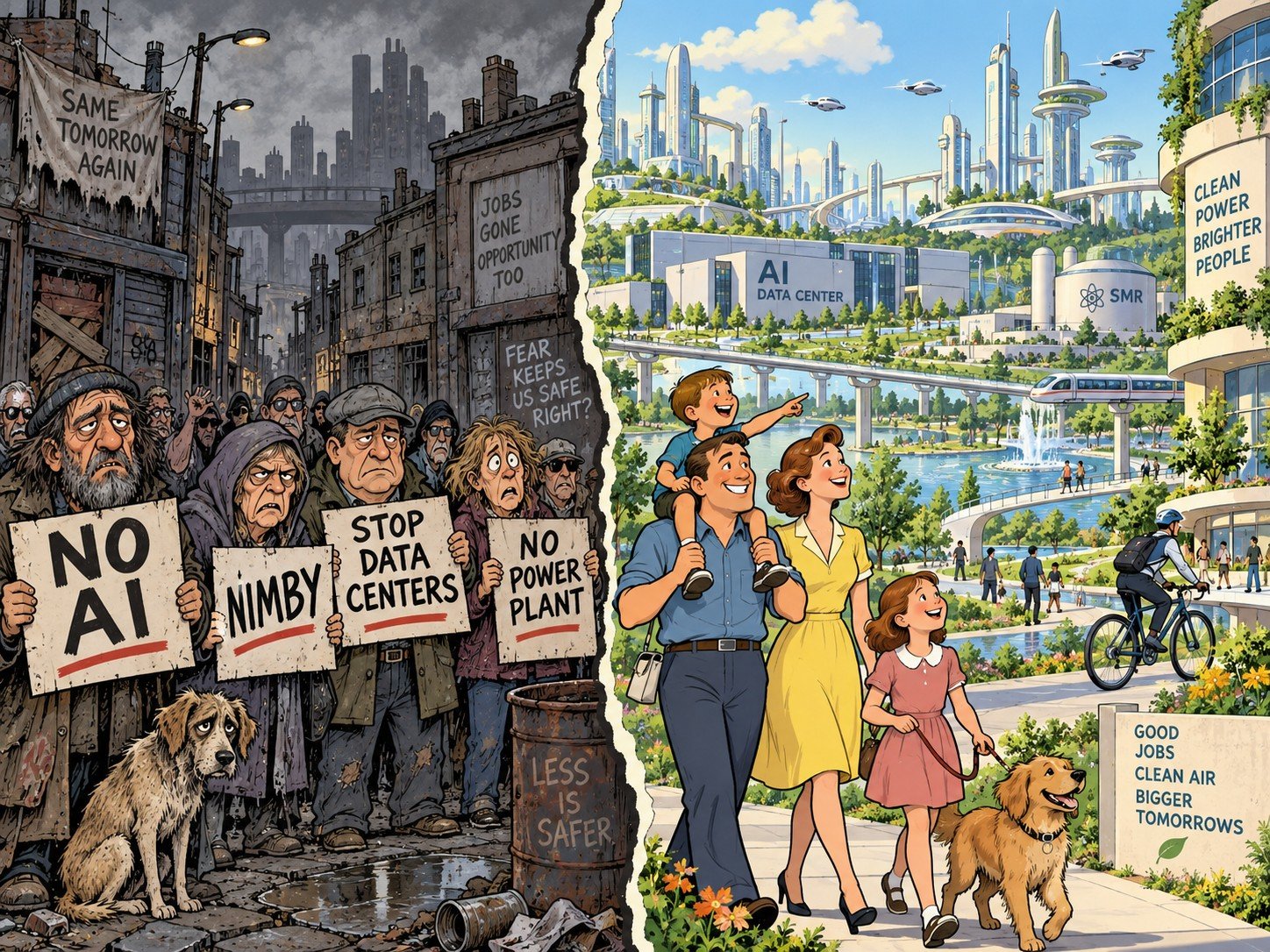
Everybody wants the future. Nobody wants the infrastructure required to build it.
Part III followed the jobs. For the finale, let’s deal with the criticism I find most persuasive: “I don’t want one next door.” Fair enough. Neither do I. I also don’t want a factory, power plant, strip club, cannabis shop or noisy bar next to my house. That’s what zoning is for. Putting industrial-scale infrastructure beside established neighborhoods is poor planning at best.
But “not next door” is very different from “not in my county.” If a properly sited data center—or an SMR—expands the tax base, increases school funding, lowers the burden on homeowners, strengthens the grid and helps lower energy costs, I want that investment in my community. Those are huge benefits. Don’t confuse stupid zoning with bad economics.
CLAIM #1: “Nobody wants one next door!” Virginia’s nonpartisan JLARC found that 29% of operational data-center properties are within 200 feet of residentially zoned land, and at least 15 data centers—roughly 10% of sites examined—generated noise residents considered problematic.
Those residents should be furious. I would be. But that’s an argument for smart zoning, not against data centers. Industrial facilities shouldn’t be shoehorned next to subdivisions, and require setbacks, noise modeling, buffers and meaningful sound limits. Loudoun County now requires additional review and noise protections near residential areas, including a 55 dBA property-line standard. That’s called land-use planning.
CLAIM #2: “They destroy neighborhoods and property values!” The evidence is less dramatic than the rhetoric. A George Mason University analysis of Northern Virginia home sales found homes closer to data centers actually sold for more, not less. That doesn’t prove data centers increase values; location, infrastructure and employment access matter too. But it certainly doesn’t support the blanket claim that data centers destroy residential property values.
Put a giant industrial building 100 feet from someone’s backyard and you may harm that homeowner. Put it in a properly zoned industrial corridor with setbacks, landscaping and noise controls and most people may barely know it’s there. Sometimes the problem isn’t the data center. It’s where somebody decided to put the damn thing.
CLAIM #3: “But what does any of this do for ordinary people?” You probably used a data center before breakfast. Email, banking, credit cards, cloud storage, streaming, e-commerce, business software, telecommunications and healthcare all depend on physical computing infrastructure.
You don’t measure the value of a power plant by counting the people inside it; you measure what electricity enables. The same is true of data centers. The cloud lives in a building, and compute is becoming a fundamental input of modern economic activity.
The bigger issue is what AI can enable: higher productivity, faster scientific discovery, better medical diagnostics and drug development, more efficient agriculture and manufacturing, lower costs, greater affordability, rising real wages and entirely new products and industries. Productivity is the foundation of wealth creation and higher living standards, and AI is the most consequential general-purpose technology since electricity.
This is also a U.S.–China race for technological leadership. The GAO says AI’s potential to spur economic growth, improve social well-being and strengthen national security is driving global competition. This is also a U.S.–China race for technological leadership. Leadership in AI means leadership in science, medicine, manufacturing, productivity, wealth creation—and increasingly, military power. I want the United States to win that race.
Americans should also ask a simple question: Why is a country racing full speed ahead on AI trying to make Americans afraid of it? 83% of China’s are pro-AI compared to just 39% in the United States. Meanwhile, China has nearly closed America’s lead in frontier AI performance and continues to push aggressively in research, patents, robotics and compute.
In June 2026, OpenAI exposed a Chinese propaganda operation creating anti-data-center content while posing as Americans; two months later, X identified a suspected Chinese network of roughly 200,000 accounts, including about 200 specifically trying to manipulate the U.S. AI and energy debate. That doesn’t mean every critic is a bot or every concern is illegitimate. But ask yourself why a strategic competitor that enthusiastically embraces AI at home would covertly amplify resistance to it here. The answer isn’t hard to figure out.
SO WHAT DID WE LEARN?
Bad siting is bad planning. Noise can be regulated. Neighborhoods can be protected. Those are zoning problems—not reasons to kneecap the infrastructure behind the next technological revolution.
AI has the potential to transform mathematics, physics, medicine, energy, manufacturing and productivity on a scale we can barely imagine. The future doesn’t have to be Terminator. It can look a lot more like Star Trek.
But only if we let the technology flourish. Build intelligently. Regulate intelligently. Protect neighborhoods. And stop mistaking progress for peril. The question isn’t whether we build the future. It’s whether America builds it—or someone else does.
Mark Lazar, MBA
CERTIFIED FINANCIAL PLANNER™