
From horse-drawn carriages to artificial intelligence, the remarkable history of protecting the public from progress.
By Mark Lazar | Wasatch Finance
In 1865, Britain’s Parliament limited self-propelled vehicles to four miles per hour in the countryside and two in towns. Additionally, someone had to walk ahead carrying a red flag to warn pedestrians and horses of the approaching menace. Why? For public safety, of course!
The Red Flag Act endured for three decades. Imagine developing an automobile industry while requiring a pedestrian escort for every car. Fortunately, we’ve evolved beyond such nonsense. Or have we?
Early elevators required operators to navigate floors and open doors. Automatic elevators eliminated that job while offering faster, cheaper, more convenient service.
What’s not to like? Quite a bit, apparently, if your livelihood depended on operating elevators.
In New York City, service unions opposed automated elevators in the 1930s and ’40s, highlighting accidents, crime, and the dangers of riding without trained operators. They even advocated legislation requiring lobby attendants in buildings with automated elevators. For public safety, naturally.
The proposal failed. Automation prevailed. Today, we’d find it peculiar if a trained professional insisted on accompanying us to the fourth floor.
Fast-forward to the emergence of Uber and Lyft. For decades, municipal governments controlled taxi markets through licensing requirements, regulated fares, and artificially limited medallions. In New York City, medallions became assets worth approximately $1 million, not because a metal plate possessed extraordinary economic value, but because the government restricted competition. Then along came ridesharing apps.
Riders could summon cars, track drivers, and see estimated fares on their phones. Predictably, taxi interests challenged ridesharing over licensing, insurance, and passenger safety.
Some concerns were legitimate; others conveniently protected the value of existing licenses. Consumers, meanwhile, embraced the technology.
When Tesla began selling vehicles directly to consumers, dealer associations invoked franchise laws and consumer protections to defend traditional distribution channels.
Apparently, buying a car directly from its manufacturer was a danger from which Americans needed government protection. Economists have a name for much of this behavior: rent-seeking. Rather than competing by innovating, delivering better products, lower prices, or greater value, established interests use political influence, regulatory restrictions, and scare tactics to protect their economic positions.
The benefits accrue to a privileged few, while the costs are borne by millions of consumers. An extraordinarily effective arrangement, conveniently justified in the name of public safety.
New technologies do pose real risks: elevators malfunction, cars crash, and drivers make mistakes. But acknowledging risk isn’t the same as justifying prohibition.
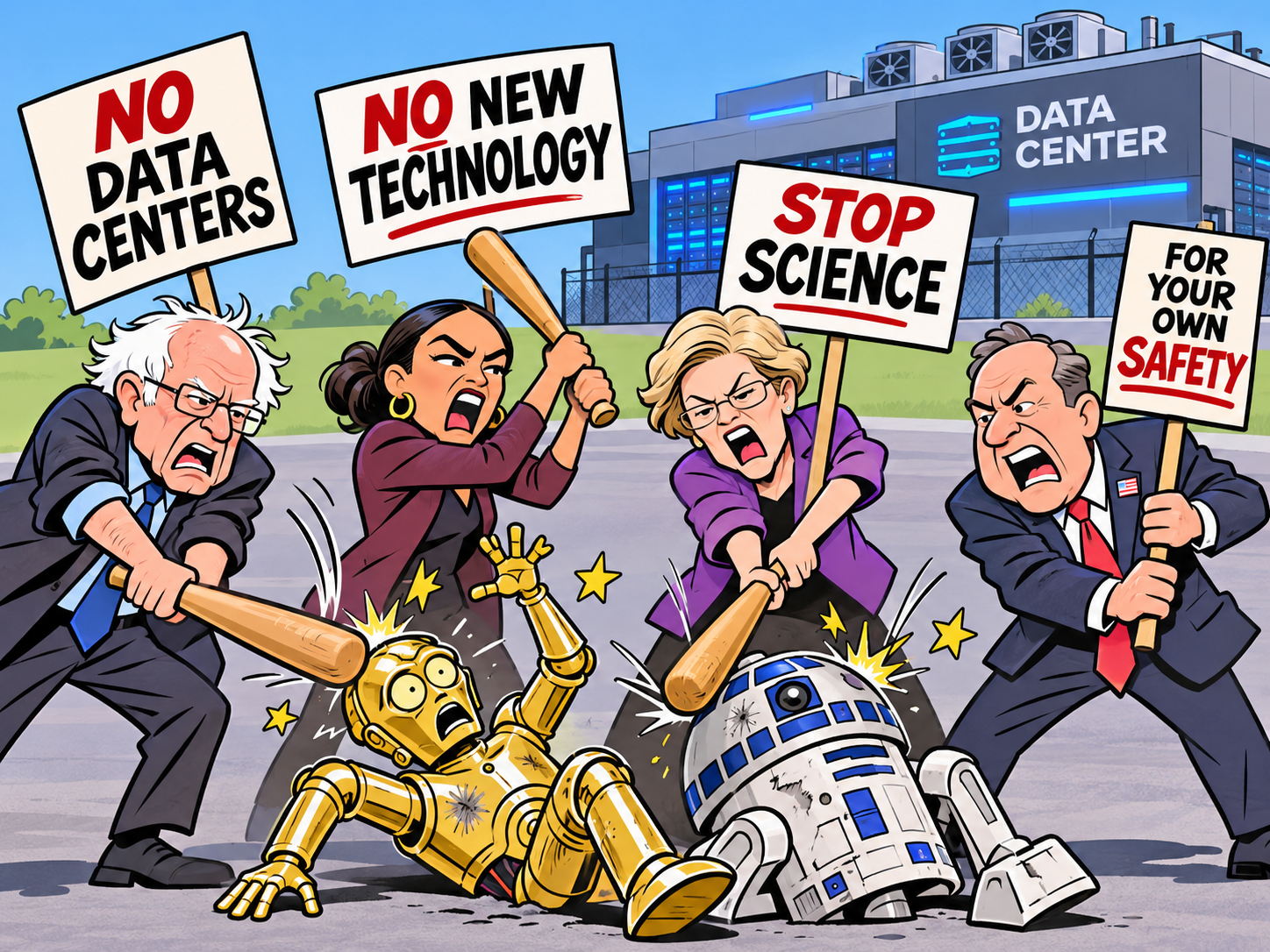
Which brings us to the November 2026 elections and mounting opposition to AI and the data centers that power it.
Candidates in both parties discovered a compelling message: AI is coming to destroy your community.
Data centers will drain our water, devour farmland, overwhelm the grid, raise utility bills, depress property values, and eliminate jobs. Then, presumably, the machines become Skynet and exterminate humanity.
According to AP reporting, restrictions prevailed in 44 of 45 completed local data-center referendums in November. Anti-data-center candidates enjoyed electoral success.
I find this troubling—not because data centers deserve immunity from scrutiny, but because we’ve seen this movie before.
Much of the debate leans on dated assumptions about water consumption, overlooks improved cooling technologies, and discounts substantial economic benefits. Of course, electricity, water, and infrastructure impacts warrant serious scrutiny; their costs should not be shifted to existing ratepayers.
Smart municipalities require developers to boost power generation, upgrade the grid, bear their infrastructure costs, and protect ratepayers. In return, data centers can deliver substantial property taxes, construction and technical jobs, investment, and a stronger local economy. Hardly the promised apocalypse.
And consider what AI could make possible: faster discovery of disease treatments, cheaper healthcare, accessible diagnostics, more efficient manufacturing, and productivity gains across industries. Imagine months rather than decades of medical research, or dramatically cheaper goods and services.
The potential expansion of productivity, wealth, and abundance is extraordinary. Yet the political debate fixates on the electricity needed to achieve it. And for the record; there’s a direct correlation between a nation’s energy output and income per capita.
If electricity is needed, have developers fund generation and transmission. If water is scarce, price it properly and demand efficient cooling. For noise and environmental impacts, enforce objective standards and sensible siting.
Not every data center is viable or appropriate. Some belong elsewhere; others shouldn’t be built. Capital should follow sound economics, not subsidies, fanciful projections, or political favoritism.
Those decisions are generally better made through markets, property rights, and fair, predictable rules than through fear-driven campaigns.
America is competing for leadership in a technology as transformative as electricity, automobiles, or the internet. While we promote Red Flag laws, other nations invest in the infrastructure of future growth, scientific advancement, and prosperity.
A century from now, our descendants will view this AI debate as we view laws requiring someone with a red flag to walk ahead of an automobile.
They may wonder why we were so determined to impede technologies capable of transforming prosperity. After all, history is filled with innovation being stopped for the greater good, and everyone living happily ever after.
But this time is different, right?
Mark Lazar, MBA
CERTIFIED FINANCIAL PLANNER™
Mark Lazar is the Managing Partner of Wasatch Finance and a former financial advisor and adjunct professor of finance. His commentaries explore economics, capital markets, public policy, and the forces shaping American prosperity.