
“Words, words, words.” William Shakespeare, Hamlet
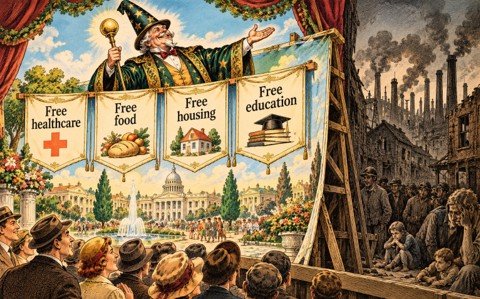
Words matter. Change their meaning and you can change the debate without changing the facts. Consider “democratic socialism.” Democracy sounds good. Fairness sounds good. Helping people sounds good. What could possibly go wrong?
Before answering, let’s ask a simpler question: What is socialism?
Capitalism rests on private property, voluntary exchange, competition, and the profit motive. In stark contrast, socialism substitutes social or collective ownership or control of productive resources. In Marxist theory, socialism represents a stage on the road to communism. Adding “democratic” describes how its proponents intend to exercise power—but doesn’t change the destination.
There are distinctions worth noting. Senator Bernie Sanders has frequently cited Sweden and Denmark as models for America. Yet despite generous social entitlements, these countries remain capitalist economies. The Democratic Socialists of America (DSA) envision something fundamentally different. Their own constitution rejects an economic order based on private profit and advocates democratic control—meaning government control—of production, resources, and planning. Their political program explicitly calls for replacing capitalism with socialism. Their words, not mine.
Redistributing a portion of capitalism’s output is not the same as replacing the system that produces it.
Now consider the American experiment. Our Founders disagreed on plenty, including the federal government’s economic role. Yet they established a constitutional republic built upon individual rights, divided powers, federalism, and limited government. Their premise was revolutionary: individual rights precede government. They are not favors dispensed by it.
In 1905, the federal individual income-tax rate was zero. Washington relied primarily on tariffs and excise taxes. The Constitution authorized federal taxation, but the vast redistributive apparatus we know today was hardly what the Founders envisioned. Neither was an administrative state in which unelected bureaucrats issue binding regulations governing countless economic decisions. Congress delegates that authority today, but what’s lawful under modern constitutional doctrine and what’s faithful to the Founders’ vision are two different questions.
The Founders also understood something modern political slogans frequently obscure: majority rule must have limits. Without constitutional restraints, pure democracy devolves into mob rule. An economic policy doesn’t become compatible with individual liberty simply because 51% of voters approve it.
The economy isn’t a fixed pie waiting to be divided. Wealth is created, through work, saving, innovation, capital formation, and risk-taking. Entrepreneurs invest because they believe they can produce something customers value. Profits signal success; losses indicate resources are better employed elsewhere. Prices communicate information no central planning committee could possibly collect or process as efficiently.
Redistribution transfers purchasing power but doesn’t create additional wealth. In fact, it does the very opposite, by diverting resources from productive investment to consumption while altering incentives. Reward something and you get more of it. Tax or penalize something and you get less. As Charlie Munger famously observed, “Show me the incentive and I’ll show you the outcome.”
Consider how far the political conversation has traveled. Three decades ago, Bill Clinton signed welfare reform, endorsed fiscal restraint, and approved capital-gains tax reductions. Today, expanded federal entitlements, aggressive redistribution, and proposals for public control of major industries have become prominent features of progressive politics. That doesn’t make every Democrat a socialist, but it illustrates how dramatically the political landscape has shifted.
The DSA makes no secret of its destination. Its immediate reforms are stepping stones toward replacing capitalism. Whether other politicians share that ultimate objective is a separate question. But the organization’s intentions are published on their website.
Government certainly has legitimate responsibilities: protecting individual rights and property, maintaining the rule of law, enforcing contracts, preserving national security, and addressing genuine harms. The question isn’t government versus no government—it’s limited government protecting our freedom versus expanding government increasingly usurping our individual liberties and determining the outcome.
Every dollar you spend represents an economic vote. Every investment reflects individual judgment. Every voluntary exchange occurs because both parties expect to benefit. Free markets allow millions of people with different priorities to cooperate without asking Washington’s permission. Contrast that with centralized economic planning, where Adam Smith’s invisible hand gives way to the iron fist of government.
Thanks to the Founders’ extraordinary vision, in America, the individual—not the state—is sovereign. Government exists to serve the people, not the other way around. Contrast that with communist regimes where the state dominates economic and political life and the people exist to serve the state.
Ultimately, capitalism is economic freedom, including the freedom to succeed—and to fail. Socialism, particularly in its Marxist formulation, aspires toward economic equality under the principle: “From each according to his ability, to each according to his needs.”
But consider the incentives. Would Henry Ford, John Rockefeller, Thomas Edison, or Elon Musk have taken the same risks, worked as relentlessly, and created the same extraordinary wealth if their reward were no different from Homer Simpson’s?
As Adam Smith explained, we don’t get our bread from the benevolence of the baker, but from his self-interest. When inventors, scientists, entrepreneurs, and investors are rewarded for innovation, effort, and risk-taking, they create wealth that ultimately benefits society. Is it any surprise that 17 of 20 of the most valuable companies in the world were founded/based in the US?
In summary, capitalism doesn’t promise equal outcomes. Rather, it provides the freedom and incentives to achieve extraordinary ones.
Mark Lazar, MBA
CERTIFIED FINANCIAL PLANNER™