
Technology is the mechanism by which humanity takes vacation from survival.
By Mark Lazar | Wasatch Finance
For most of human history, poverty wasn’t a social problem to be solved. It was the natural condition of mankind.
A farmer in seventeenth-century Europe lived a life remarkably similar, economically speaking, to his ancestors centuries earlier. Most people worked from sunrise to sunset producing food, clothing, and shelter. Life expectancy was short, infant mortality was high, and discretionary income was virtually nonexistent.
Wealth existed, of course, but was concentrated among monarchs, aristocrats, and landowners. Economic growth followed population growth. More people meant more labor and greater aggregate output, but little improvement in prosperity per person.
Then something extraordinary happened. Beginning with the Industrial Revolution, expanding trade, stronger property rights, technological innovation, and increasingly competitive markets fundamentally altered humanity’s economic trajectory.
Machines multiplied human labor. Capital accumulated. Entrepreneurs developed better products and production methods, while competition rewarded efficiency and punished failure. The result was unprecedented wealth creation.
For centuries preceding industrialization, global output per person grew at a glacial pace. Since the nineteenth century, however, real income per person has multiplied many times over. What took humanity millennia to achieve was eclipsed in little more than two centuries.
The lesson is profound: Prosperity isn’t created by dividing wealth. It’s created by producing more of it.
Nowhere has this principle been more evident than in the United States. Following World War II, America and Western Europe enjoyed decades of economic expansion. European productivity gradually converged toward American levels, but that convergence slowed in the 1970s then stalled in subsequent decades.
By 2025, America’s economy generated approximately $30.8 trillion in annual output, compared with $21.2 trillion for the European Union. More importantly, Europe’s output per person remains substantially below America’s. Why?
Both America and Europe embraced increasingly expansive welfare states during the twentieth century. America’s transformation began with FDR’s New Deal and accelerated under LBJ’s Great Society. Europe took government intervention considerably further.
Today, government expenditures represent approximately 38% of U.S. GDP, compared with 44% in the United Kingdom, 50% in Germany, and 57% in France.
Consider the implications. In France, annual government expenditures equal considerably more than half the nation’s economic output, and represent an enormous claim on economic resources that must ultimately be financed.
And therein lies a fundamental economic problem: The larger government’s claim on national income, the greater the potential burden on private capital formation, investment, and wealth creation.
Europe’s challenges extend beyond taxation. Its regulatory environment, labor protections, fragmented capital markets, and climate and energy policies have made it increasingly difficult to build and scale innovative enterprises.
European industrial electricity prices are now two to three times American levels, while natural gas prices have been four to five times higher. In an increasingly digital, automated, and compute-intensive world, affordable energy is foundational to economic competitiveness.
Consider SpaceX, Microsoft, Apple, Google, Amazon, Nvidia, and Meta. These American companies have created trillions in shareholder value while fundamentally transforming global commerce, communication, and productivity.
Europe possesses exceptional engineers, sophisticated businesses, and world-class universities. What it has struggled to replicate is America’s capacity to finance, commercialize, and scale disruptive innovation.
The distinction is also reflected in the origins of great fortunes. Roughly three-quarters of America’s billionaires are self-made, while inherited fortunes account for a considerably larger share of billionaire wealth in countries such as Germany, France, and the UK.
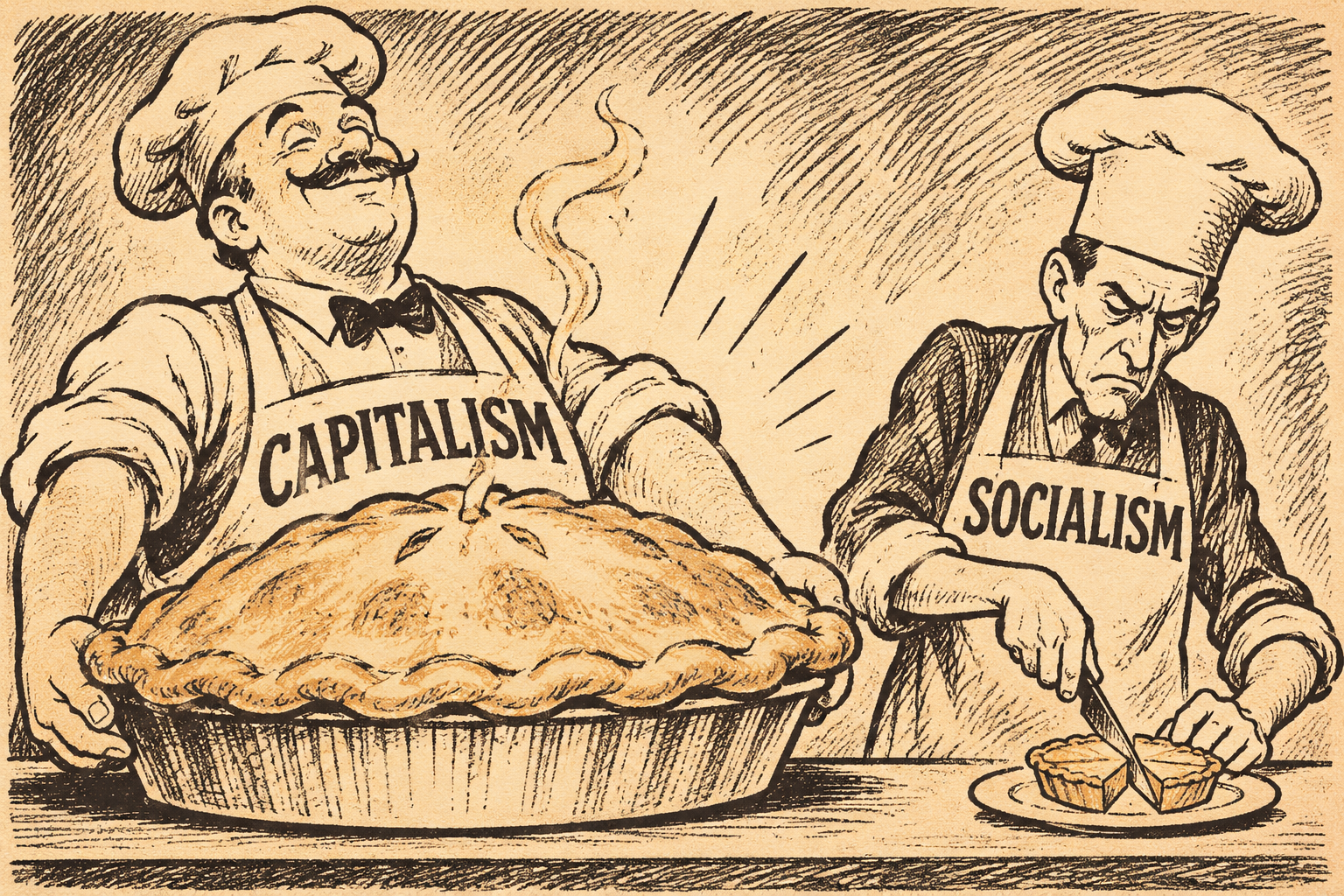
Much of today’s political debate treats wealth as though it were a fixed pie. If one person possesses a larger slice, the assumption is that someone else must have received a smaller one. Government’s responsibility then becomes redistributing those slices in pursuit of a more equitable outcome.
Consider the smartphone. Thirty years ago, no billionaire could purchase the computing power, global communication, navigation, and access to information that an ordinary person carries in his pocket today. That wealth didn’t exist. Entrepreneurs, engineers, investors, and competitive markets created it.
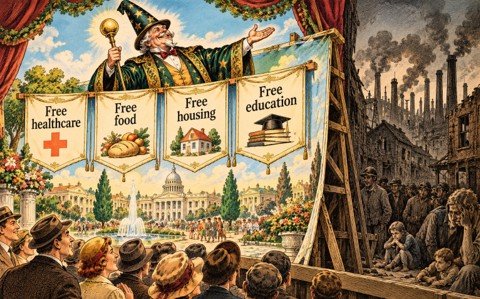
This isn’t an argument against a social safety net. A prosperous society can and should protect those genuinely unable to provide for themselves. But there’s an enormous difference between providing a safety net and constructing an economic system that increasingly punishes production while subsidizing consumption.
Taxes alter incentives. Regulations impose costs. Government spending competes for scarce resources. Every dollar directed toward a government priority has an opportunity cost. The relevant question isn’t whether its intentions are noble, but whether its benefits justify the resources consumed.
The choice isn’t between capitalism and compassion. It’s between an economic system that prioritizes creating opportunity and one increasingly preoccupied with allocating the proceeds.
Free markets aren’t perfect. They produce failures, inequalities, and occasional excesses. But no alternative has matched their capacity to mobilize capital, reward innovation, raise productivity, and improve material living standards on a massive scale.
The objective of economic policy shouldn’t be equality of outcome. It should be to create the conditions under which tomorrow’s output/wealth becomes so much larger that virtually everyone can enjoy a higher standard of living.
The pathway to prosperity isn’t smaller slices. It’s a larger pie.
Mark Lazar, MBA
CERTIFIED FINANCIAL PLANNER™
Mark Lazar is the Managing Partner of Wasatch Finance and a former financial advisor and adjunct professor of finance. His commentaries explore economics, capital markets, public policy, and the forces shaping American prosperity.